Most people never look at their water heater until it stops working. It sits in a basement, garage or cupboard, keeping a big tank of water hot all day and all night, whether anyone is home or not.
That makes it one of the larger energy users in a typical house, and also one of the easiest to adjust. Many tanks leave the factory, or get installed, at a higher setting than a household actually needs. Turning it down a notch costs nothing and takes a few minutes.
There are a couple of safety points to get right first, though, and one health consideration that is worth knowing about before you start twisting dials.
Find out what temperature it is set to now
Gas water heaters usually have a dial on the front of the gas valve near the bottom of the tank. Some show actual temperatures; many only show words like "warm," "hot" and "very hot," or letters, which is not very helpful.
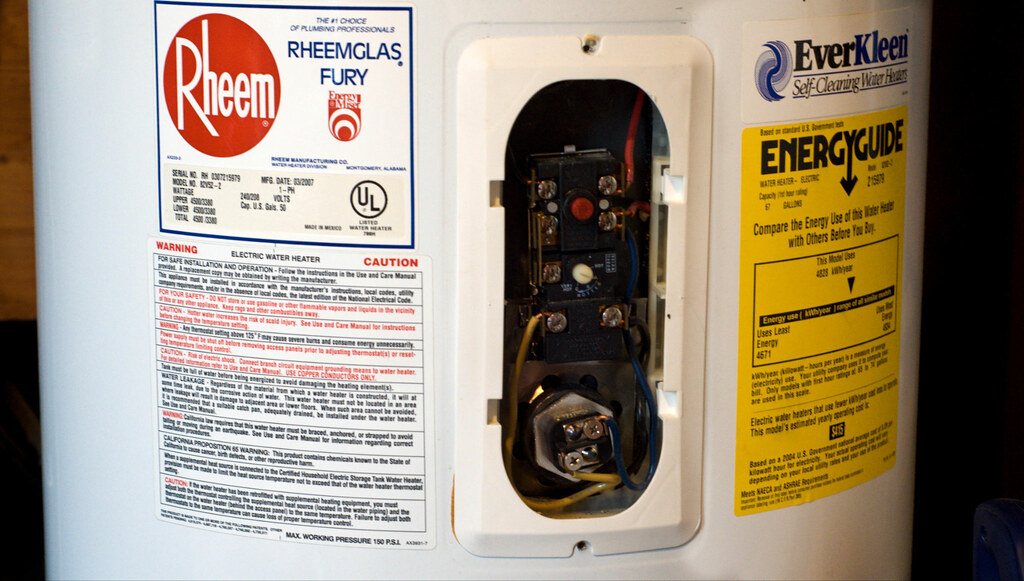
Electric tanks are different. The thermostats sit behind one or two metal panels on the side, often with insulation behind them, and there are live electrical parts in there. Do not open those panels with the power on. (The photo above shows what is behind one, and it is not a place for fingers.)
The simplest way to find your real temperature is to measure it. Run the hot tap closest to the heater for a couple of minutes, then hold a kitchen thermometer in the stream. That tells you what is actually coming out, which matters more than whatever the dial claims.
The setting most homes can live with
The U.S. Department of Energy suggests 120°F (about 49°C) as a setting that works for most households, and points out that many heaters are set to 140°F by default. Water at 120°F is still hot enough for showers and washing up, and it is also less likely to scald, which matters a lot in homes with small children or older relatives.
Here is the health caveat. Bacteria called Legionella can grow in water that sits warm for long periods, and some health agencies, including in the UK, recommend storing hot water at around 60°C (140°F) and using mixing valves at taps to prevent scalding. Which advice applies to you depends on where you live and who lives with you. If anyone in the house has a weakened immune system, check with your local health guidance or a plumber before turning the tank down. This is one of those cases where saving money is not the only thing to weigh.
How to turn it down safely
For a gas heater, turn the dial on the gas valve down a step, wait a day, and measure again at the tap. Small changes are easier to judge than big ones.
For an electric heater, switch off the power at the breaker first and confirm it is off. Remove the access panel, fold back the insulation and use a flat screwdriver to adjust the thermostat. Many tanks have two (upper and lower), and they are usually set to the same temperature. Put everything back before turning the power on again. If you are not comfortable working around wiring, a plumber or electrician can do this in a few minutes during any other visit.
Whichever type you have, give it a day to settle and measure at the tap again before making any further change.
Four other cheap fixes while you are there
Insulate the pipes. Foam pipe sleeves on the first few feet of hot water pipe coming out of the tank cut heat loss and are cheap at any hardware store. Keep them clear of the flue on a gas heater.
Check whether an insulation blanket makes sense. Older tanks lose a lot of heat through their sides and some benefit from an insulating jacket. Newer tanks are often already well insulated, and some manufacturers advise against blankets, so read the label first. On gas models, never cover the top, the burner area or the controls.
Use the vacation setting. Many gas heaters have a "vacation" or pilot setting that keeps the pilot lit but stops heating the tank while you are away.
Fix dripping hot taps. A slow drip of hot water is money disappearing down the drain one drop at a time, and a new washer or cartridge is usually a cheap repair.
When the trick will not help much
If your water heater is tankless, it only heats water as you use it, so the standby savings from turning it down are much smaller. Lowering the setting can still reduce scald risk, but do not expect a big change on the bill.
Turning the tank down also will not fix a heater that is failing. Rumbling or popping noises often point to sediment at the bottom of the tank, rust colored hot water can mean corrosion, and any water pooling under the heater is a reason to call a plumber rather than to keep adjusting dials. Draining sediment is a common annual job, but the water coming out is very hot, so follow the manufacturer's instructions and switch off the heat source first.
For most people, though, the whole fix comes down to one measurement, one small adjustment and a second measurement the next day. It is about as low effort as money saving gets.
See more of us on GoogleAdd Hacks Detective as a preferred source and our stories can show up more often for you in Top Stories.