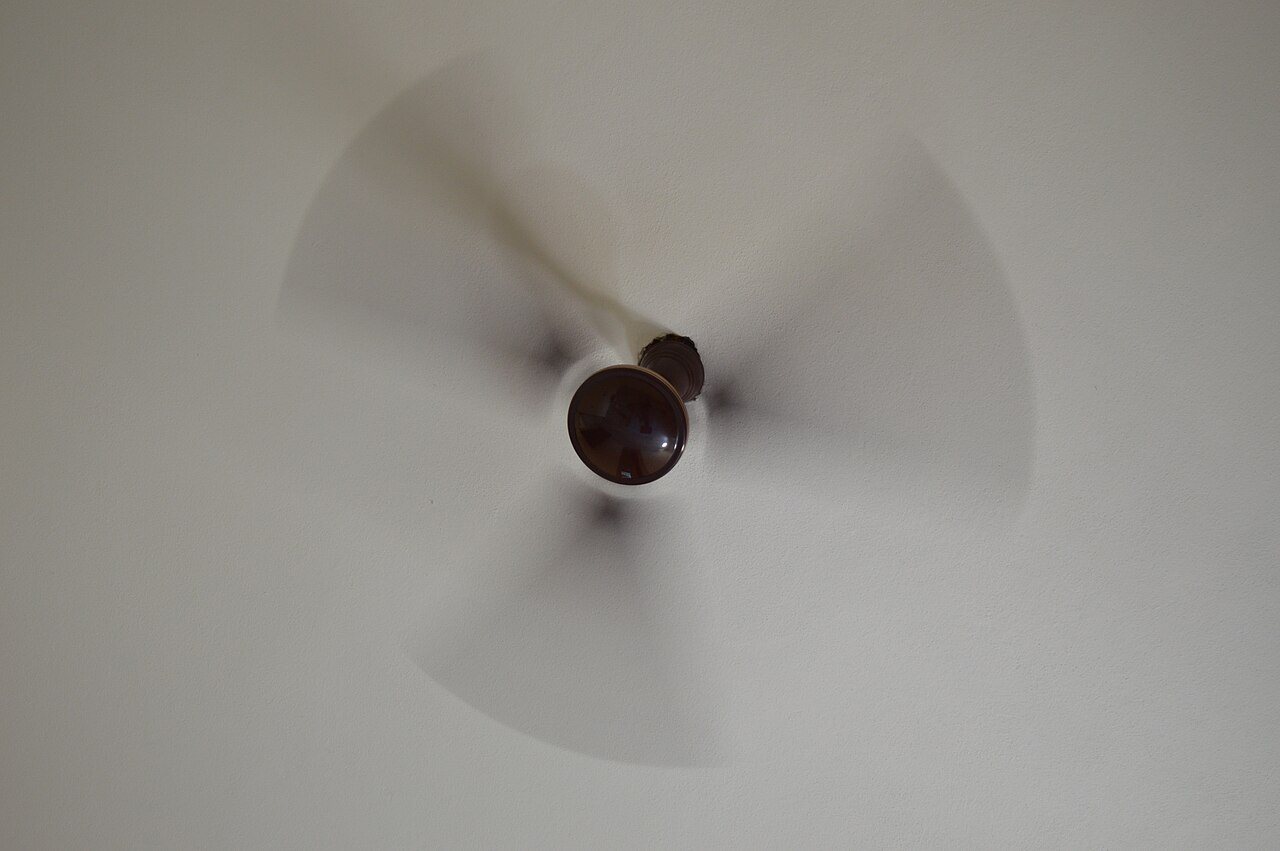
Stand on a chair in a heated room and put your hand near the ceiling. It is warmer up there, sometimes noticeably so, because warm air rises and pools at the top of the room while you sit in the cooler layer below. Your heating is paying to warm the one part of the room nobody uses.
Most ceiling fans have a fix for this built in, and plenty of people have never touched it. On the motor housing there is usually a small slide switch that reverses the direction of the blades. Set the right way in winter, the fan pushes that warm air back down without blasting you with a breeze.
It is not magic and it won't replace your heating. But it costs nothing to try, and in the right room it makes a real difference to how warm you feel.
Which way is the winter setting
Stand under the fan and look up. For winter, you want the blades turning clockwise, on the lowest speed.
At that setting, a typical fan pulls air up toward the ceiling in the middle of the room. That air has to go somewhere, so it spreads out across the ceiling, runs down the walls and drifts back across the floor. Along the way it mixes the warm layer at the top into the rest of the room. Because the airflow comes down along the walls rather than straight at you, you don't feel a draft.
In summer you do the opposite: counterclockwise, at a higher speed, so the fan pushes air straight down and you get the wind-chill effect that makes you feel cooler.
One caveat. Blade pitch varies, and a few fans are built the other way round. If you are not sure, switch it on low, stand underneath, and feel for air. In winter mode you should feel very little directly below the fan. If you feel a steady downward breeze, flip it.
How to flip it safely
Turn the fan off at the wall or with the pull chain and wait until the blades have stopped completely. Don't try to reach the switch while they're still turning, even slowly.
Use a proper step stool or ladder rather than a wobbly chair. The switch is usually a small slider on the side of the motor housing, just above or below where the blades attach. On many newer fans, especially ones with DC motors, there is no switch on the fan at all and the reverse button is on the remote or the wall control. Check the manual if you can't find it; most are online.
While you're up there, wipe the tops of the blades. They collect a startling amount of dust over a summer, and the first spin in a new direction will drop it on whoever is sitting below. (Ask me how I know.)
Why it can make the room feel warmer
The fan does not add any heat. A ceiling fan on low uses very little electricity, but all it can do is move the air you have already paid to warm.
What it changes is where that warmth ends up. Without the fan, the thermostat on the wall may be reading the cooler air at chest height while the warmest air sits uselessly against the ceiling. Mixing the room evens out the temperature, so the space you actually occupy gets a bit warmer for the same amount of heating. Some people find they can turn the thermostat down slightly and feel just as comfortable. That is where any saving comes from.
When it won't do much
This trick works best in rooms with high or vaulted ceilings, where a lot of warm air collects far above your head. In a small room with a standard ceiling, the difference between the top and the bottom is smaller, so there's less to gain.
It also does nothing for an empty room. Fans make people more comfortable; they do not change the temperature of a room you are not in. Switch the fan off when you leave, the same as you would a light.
And if your fan wobbles or ticks at low speed, mixing the air is not worth the noise. Tightening the blade screws often fixes that, but a fan that still wobbles after that needs a closer look.
The two-minute version
Turn the fan off and let it stop. Flip the direction switch so the blades turn clockwise when you look up at them. Run it on the lowest speed while you're in the room. If you feel a draft directly underneath, it's going the wrong way.
Then, come spring, flip it back. I put a reminder in my calendar for the weekend the clocks change, which handily is also when I test the smoke alarms.
See more of us on GoogleAdd Hacks Detective as a preferred source and our stories can show up more often for you in Top Stories.