Photo: anemoneprojectors, CC BY-SA 2.0, via Wikimedia Commons
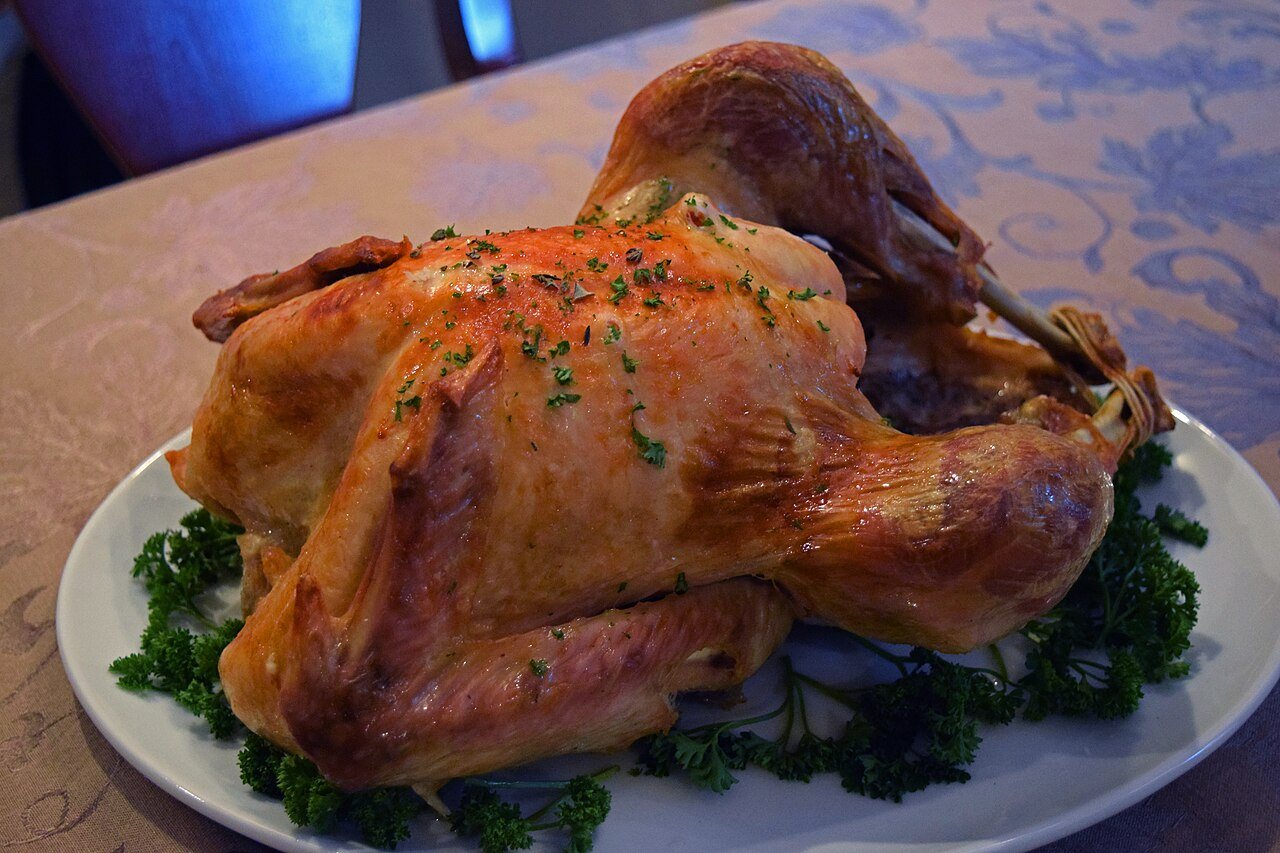
The picture in everyone's head is the same: a golden bird on the table, someone standing over it with a long knife, carving thin slices off the breast while the family watches. It looks great in a painting. In real life it tends to produce ragged slices, a lot of meat stuck to the bones and a carver who's sweating by the second wing.
There's an easier way, and it's the one a lot of chefs teach. Take the bird into the kitchen, remove the legs and wings, lift each breast off the bone in one piece, and then slice it across the grain on a cutting board. You give up the tableside moment, but you get neat slices with skin on every one, and the whole job takes about ten minutes once you've done it once or twice.
Here's the method step by step, and why it works.
Let it rest first, and check it's done
Before you carve anything, make sure the turkey is cooked through. The USDA says turkey is safe at 165°F, measured with a food thermometer in the thickest part of the breast, the innermost part of the thigh and the innermost part of the wing. Pop-up timers are a rough guide at best.
Then leave it alone. Tent the bird loosely with foil and let it rest on the board or in the pan for at least 20 minutes, and up to 40 for a big one. The juices settle back into the meat instead of running all over the board, and the bird gets easier to handle. It'll stay plenty warm (a whole turkey holds its heat far longer than people expect), and the rest gives you time to make the gravy.
Gear that makes it easier
You need less than you'd think. A sharp chef's knife or carving knife does the job, and sharp matters more than long. A big cutting board with a groove around the edge will catch the juices. Put a damp kitchen towel under the board so it doesn't slide around.
A pair of tongs or a carving fork helps steady the bird. Paper towels are useful for gripping a hot leg. An electric knife works too, if you've got one in a drawer somewhere from the 1980s, though I don't think it's needed with this method.
Step 1: Take off the legs and wings
Set the turkey breast side up. Pull one leg gently away from the body and cut through the skin between the leg and the breast. Keep pulling the leg outward and down until the thigh joint pops out of its socket, then cut through the joint and the remaining skin. The whole leg should come away in one piece.
Repeat on the other side. Then separate each drumstick from its thigh by cutting through the joint between them. If you wiggle the drumstick you'll feel where the joint is, and the knife should go through without much force. If you're hitting bone, move the blade a little.
For the wings, pull each one out from the body, find the joint where it meets the breast, and cut through it.
Step 2: Lift each breast off whole
This is the step that makes the biggest difference. Find the breastbone, the ridge running down the middle of the top of the bird. Make a long cut along one side of it, from front to back, keeping the knife close to the bone.
Now work down the side of the ribcage with short strokes, pulling the breast meat away from the bones with your other hand as you go. The whole breast half will peel away in one big piece, skin and all. Do the same on the other side.
Don't worry if it isn't perfect the first time. Whatever meat you leave on the frame isn't wasted, because it'll go into stock.
Step 3: Slice across the grain
Lay each breast skin side up on the board. Look at the meat and you'll see the muscle fibres running lengthwise. Slice across them, crosswise, into pieces about half an inch thick.
That's the reason the method works. Cutting across the grain leaves the muscle fibres short in each slice, so the meat feels more tender when you eat it. Slicing on the bird, parallel to the bone, tends to do the opposite. And because each slice comes from the whole breast, every piece gets a strip of crisp skin on top, which is the part people fight over anyway.
For the thighs, cut the meat off the bone and slice it. Drumsticks can go on the platter whole for whoever wants them.
Serving it, and what to do with the bones
Arrange everything on a warmed platter, dark meat on one side and white on the other. If the slices look a little dry by the time everyone sits down, spoon a bit of warm broth or pan juice over them. It helps more than you'd expect.
A quick safety note: knives and a hot, slippery bird don't mix well, so keep the board steady and your fingers tucked. And once dinner is over, get the leftovers into the fridge within two hours, which is the USDA's rule for perishable food. Put the carcass in a pot with water, an onion and a carrot the next day and you'll have stock for soup by lunchtime.
See more of us on GoogleAdd Hacks Detective as a preferred source and our stories can show up more often for you in Top Stories.