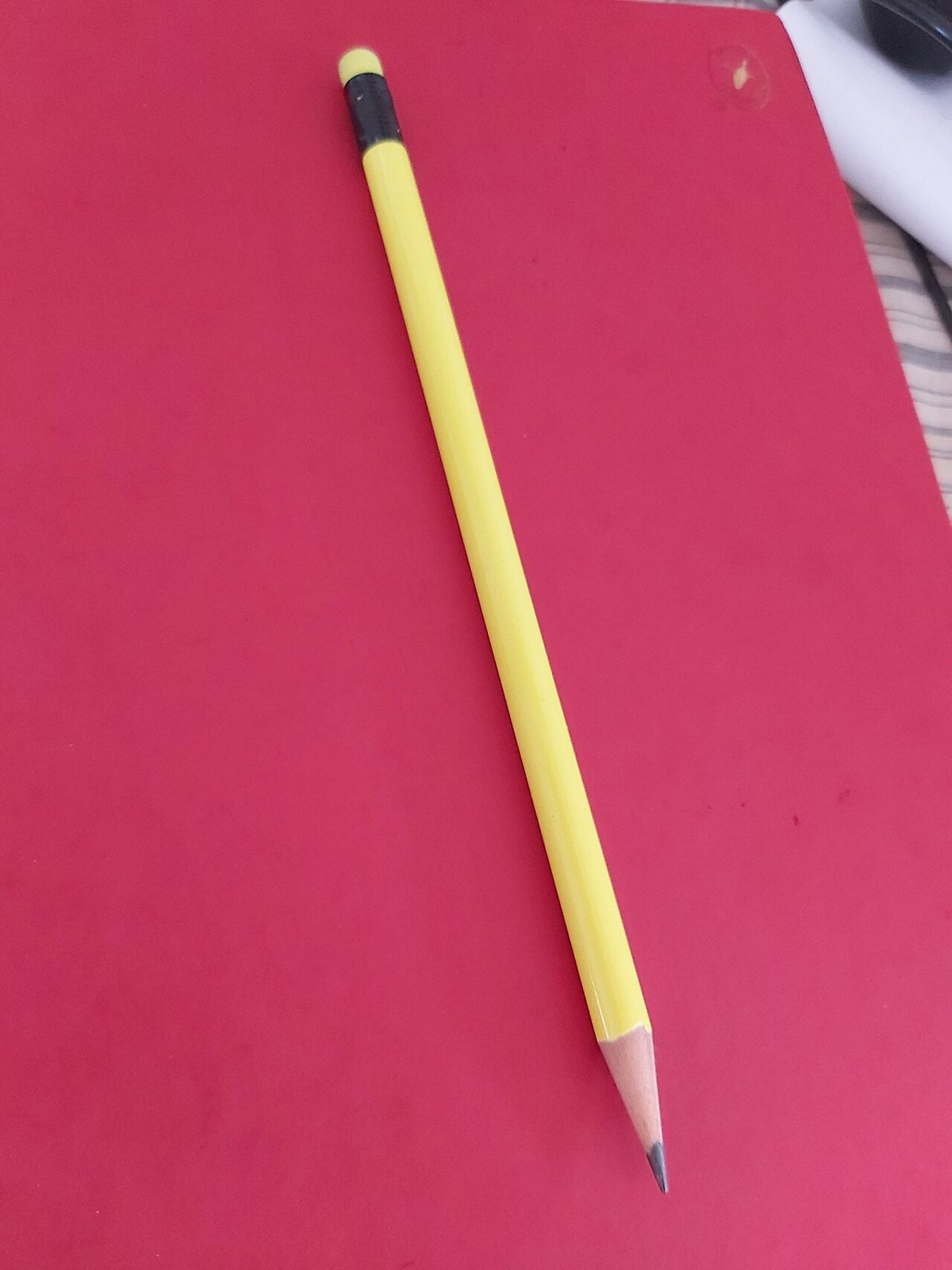
Photo: Kaviyadharshini Selvakumar, CC BY-SA 4.0, via Wikimedia Commons
Pick up a pencil from almost any office or classroom in North America and there's a good chance it's yellow, six-sided, and topped with a pink eraser held on by a little metal band. It's such a standard object that most of us have never asked why it looks that way.
Every one of those details has a reason behind it, and a couple of them are a lot odder than you'd expect. The "lead" isn't lead at all, and the yellow paint started as a branding decision in the 1880s. Even the eraser on the end has a legal history that went all the way to the US Supreme Court.
Pencil history is full of nice stories that don't quite hold up (the yellow paint has a few), so I've tried to separate what's well documented from what's just repeated a lot.
There has never been lead in a pencil
The core of a pencil is graphite, a soft form of carbon, mixed with clay. The name goes back to the 1500s, when a large deposit of unusually pure graphite was found at Borrowdale in the Lake District of England. People at the time thought the shiny black stuff was a kind of lead and called it things like "black lead" or plumbago. The name stuck long after chemists worked out what it really was.
So if you've ever worried about a child chewing a pencil, the core isn't lead poisoning waiting to happen. Pencils still aren't food, but that particular worry comes from a 16th-century mix-up.
The clay recipe from wartime France
Early pencils used sticks of pure Borrowdale graphite, which was valuable enough that the English guarded the mine. In the 1790s, with France at war with Britain and short of good graphite, the French inventor Nicolas-Jacques Conté came up with a workaround. He ground graphite into powder, mixed it with clay, shaped it into rods and fired them in a kiln.
That process is still the basis of pencil making. Changing the ratio of clay to graphite changes the pencil. More clay gives a harder pencil with a lighter line. More graphite gives a softer, darker one.
What HB and No. 2 actually mean
That's where the letters come from. H stands for hard and B for black, and an HB pencil sits in the middle. Artists use a range from very hard H grades to very soft B grades.
The American "No. 2" pencil is roughly the same as HB, though the numbers were never perfectly standardized between manufacturers, so one company's No. 2 can feel a little different from another's. For filling in bubbles on a test sheet, it was the dark-but-not-smudgy middle ground the scanning machines liked.
Yellow came from a luxury brand
The yellow paint is usually traced to Koh-i-Noor Hardtmuth, a pencil maker based in what is now the Czech Republic. In the late 1880s it launched a premium pencil, named after the famous Koh-i-Noor diamond, and painted it yellow. The usual explanation is that yellow suggested quality and the East, since some of the finest graphite of the time came from Siberia near the border with China, a country associated with imperial yellow. I'd treat that last part as the story the industry likes to tell rather than settled fact.
What isn't in doubt is that the premium yellow pencil sold well, and other makers copied the color so their pencils would look like the expensive one. In the United States, yellow became the default. In much of Europe, pencils come in all sorts of colors and stripes, which tells you how much of this is habit.
The eraser that ended up in court
Rubber got its English name because it could rub out pencil marks. The chemist Joseph Priestley noted that use in 1770.
Putting the eraser on the pencil came later. In 1858 Hymen Lipman of Philadelphia patented a pencil with an eraser attached at one end. The patent later passed to other owners, and the legal fight over a related patent reached the US Supreme Court, which ruled in 1875 that joining a pencil and an eraser wasn't really a new invention, just two existing things stuck together. The patent was invalid, and anyone could make pencils with erasers after that.
European pencils often still come without one, which is a small but reliable way to spot an American pencil in the wild.
Six sides and a few handy pencil tricks
The hexagonal shape is mostly practical. A six-sided pencil doesn't roll off a sloping desk the way a round one does, and it's easy to grip. Round pencils exist, and many artists prefer them, but the hexagon won in offices and schools.
The graphite itself has a few uses beyond writing, because it's a good dry lubricant. Rubbing a soft pencil along the teeth of a sticky zipper can help it run more smoothly. Running a pencil over the cut of a key, then working the key in and out of a stiff lock a few times, can leave a little graphite behind and loosen things up. A short safety note: don't force a lock that is properly jammed, and for anything valuable or security-related, a locksmith is the better call. Graphite also smudges onto light fabric, so keep it away from that nice coat while you work.
One last thing worth knowing next time you sharpen one: a pencil that's dull on one side writes better if you rotate it a little as you go. It keeps the point even and the line the same width, which is the kind of advice most of us got in school and promptly ignored.