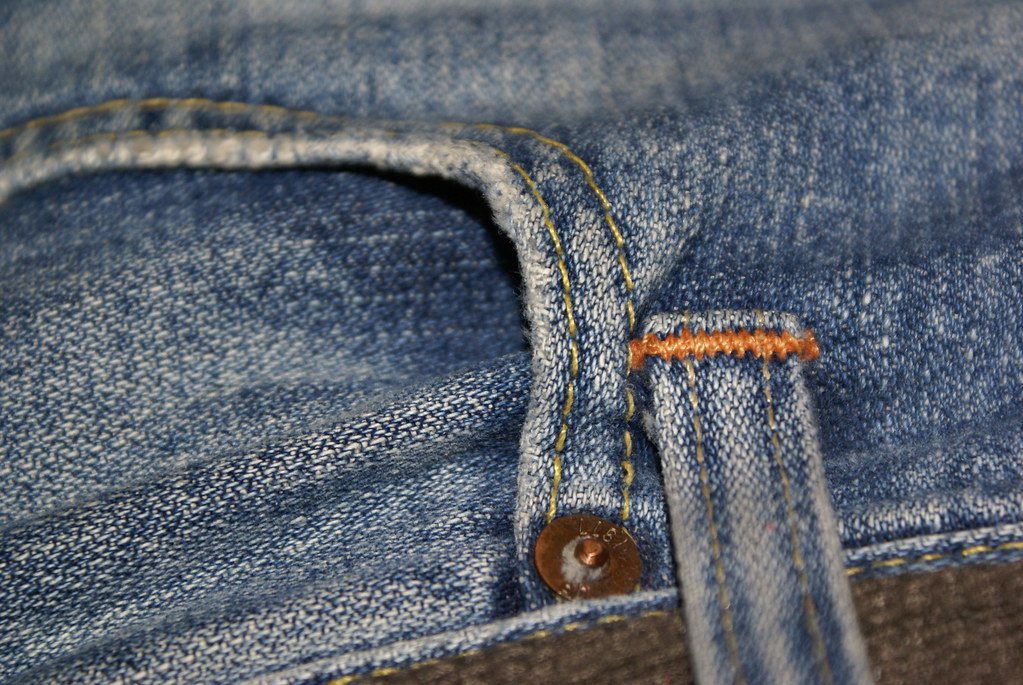
Look at the right front pocket of almost any pair of jeans and you'll find a smaller pocket sewn inside it. It's too small for a phone, a bit awkward for keys, and most people use it for a folded receipt or nothing at all. Right next to it, at the corner of the main pocket, there's usually a small copper rivet.
Neither of those details is decoration. Both were invented to solve specific problems for men doing hard physical work in the American West in the 1870s, and they have stayed on jeans for more than 150 years mostly out of habit and branding.
I went down a rabbit hole on this one, and the history turns out to be pretty well documented, much of it by Levi Strauss & Co., which has every reason to keep the story alive.
The rivet came from a tailor in Reno
The copper rivet came first. Jacob Davis was a tailor in Reno, Nevada, who made sturdy work trousers for laborers. According to the story he later told, a customer kept tearing out his pockets, so Davis hammered small copper rivets into the corners where the stress was greatest. It worked, and other customers started asking for riveted trousers.
Davis wanted a patent but couldn't afford the fee on his own. He bought his cloth from Levi Strauss, a dry goods merchant in San Francisco, so he wrote to Strauss and proposed going in together. Strauss agreed, and on May 20, 1873, the two men were granted U.S. Patent No. 139,121 for an improvement in fastening pocket openings. That date is often treated as the birthday of blue jeans.
Copper was a sensible choice. It's soft enough to set with a hammer, and it doesn't rust, which matters on clothes that get wet and muddy every day.
The tiny pocket was for a watch
The small front pocket was there on the early riveted jeans, and it was meant for a pocket watch. In the 1870s, a working man who owned a watch kept it on a chain or loose in a pocket, and a dedicated, snug pocket kept it from bouncing around or getting smashed while he worked.
Levi Strauss & Co. still calls it the watch pocket, though it has collected plenty of other names since, including the coin pocket, the ticket pocket and the match pocket. Wristwatches took over in the 20th century and the reason for the pocket vanished, but by then it was simply part of what jeans looked like. Taking it away would have looked wrong, and making it costs very little. (I'd argue it's the most ignored pocket in the modern wardrobe, narrowly beating the one on the sleeve of a bomber jacket.)
Rivets that scratched saddles and burned by campfires
Not every rivet survived. The early jeans had rivets on the back pockets too, and those had a habit of scratching saddles, chairs and school desks. Levi's covered the back pocket rivets with fabric in the 1930s and eventually dropped them altogether.
There was also a rivet at the crotch, where the seams meet. The company was rid of it by the early 1940s. Levi's own lore links the decision to a company executive who crouched too close to a campfire while wearing riveted jeans and found out how well copper conducts heat. Whether or not that's exactly how it went, you can see why nobody argued for keeping it.
The leather patch and the back pocket stitching
The patch on the back waistband has its own story. In 1886 Levi's added a leather label showing two horses trying, and failing, to pull a pair of jeans apart. It was advertising for people who might not read English well. The point was obvious at a glance: these trousers don't tear.
The curved double stitching on the back pockets of Levi's, known as the arcuate, also goes back to the early years and became one of the company's trademarks. During the Second World War, when thread was rationed, the company reportedly painted the design onto pockets instead of stitching it, so the look would stay the same.
Belt loops came later, in the 1920s. Before that, jeans had buttons for suspenders and a cinch at the back for tightening the waist.
Where the words "denim" and "jeans" came from
The names are older than the trousers. "Denim" is usually traced to "serge de Nîmes," a sturdy fabric associated with the French city of Nîmes. "Jeans" is commonly linked to Genoa in Italy, where a hard-wearing cotton cloth was made and worn by sailors and workers. Etymologists argue over the finer details of both (they usually do), but the general origins are widely accepted.
What to do with the tiny pocket today
You might as well use it. The watch pocket is a good place for anything small you don't want mixed in with keys and a phone. Think of a spare house key, a folded bill, earbuds in a small case, or a tiny USB drive. Since it sits inside the main pocket, it's also a little more secure.
Next time you buy jeans, have a look at the details. Real copper rivets, a proper watch pocket and solid stitching at the stress points are signs a pair was made with some care. Some cheaper pairs skip or skimp on them. None of that tells you everything about quality, but the rivets on a good pair of jeans are doing the same job Jacob Davis designed them for in 1873.